

Modular Chocolate Tempering System Development
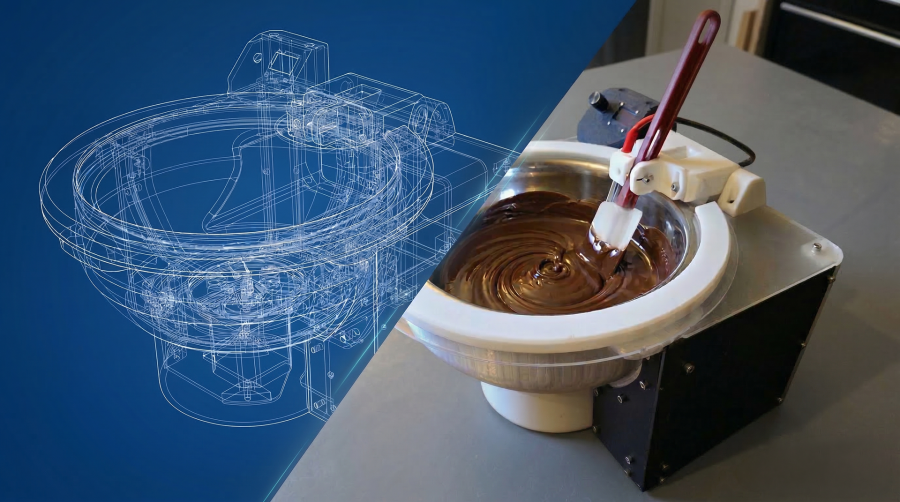
Improving operational efficiency through integrated design and live-environment testing.
Background - In collaboration with our sister company, RadChocs, we reviewed the current industrial options for chocolate tempering. The existing machinery was found to be somewhat dated in its functionality—often physically large relative to its capacity, noisy, and lacking the modern integration required for efficient small-to-medium scale production.
The Brief -The objective was to develop a more practical, UK-designed alternative. Key requirements included a smaller physical footprint with increased capacity, reduced noise levels, and a modular architecture that allowed for easier, more cost-effective maintenance. We also looked to implement a fully programmable system that could adapt to changing environmental conditions.
Technical Strategy (The Lab) - The internal focus was on creating a more intelligent control system. By moving away from static thermal controls, we implemented:
-
Environmental Monitoring: Machine learning integration to help the unit maintain consistent viscosity and temper by automatically adjusting to ambient temperature and humidity.
-
Production Integration: The ability to sync with order systems and provide real-time data logging for quality control.
-
Sensor Calibration: Integrating weight sensors and variable mixing capabilities to ensure batch consistency across different volumes.
Mechanical Execution (The Workshop) The physical build focused on simplifying the user experience and improving long-term reliability:
-
Footprint Optimisation: Redesigning the internal layout to maximize chocolate volume while reducing the overall machine size.
-
Refined Operation: Internal motor and heating assemblies were designed for quieter, more efficient operation.
-
In-house Build: Both the electronics and mechanical components were designed and prototyped in-house to ensure a cohesive, future-proofed system.
Validation and Result A critical stage of this project involved long-term testing in a live production environment. The prototype was integrated into the daily operations at RadChocs, allowing for rigorous testing against real-world variables.
This process was essential for refining the software and mechanical durability, ensuring that the machine has already proven its worth in a commercial setting. Following the success of these trials, we are continuing to develop the system with the aim of producing a commercial product for broader industry use.
 Print
Print 